Lesson 8 · Hiragana
や ゆ よ
A short lesson, because this is a short row. Three characters, not five.
The chart would predict yi and ye in the two empty slots. Japanese has neither, so the row has three members and the gaps are simply gaps — the same honesty you saw at し and ち, made visible in the grid itself.
Scroll
Warm up
Thirty-five so far, twice each. The longest review yet.
や — ya
-
や
ya
A yacht with an anchor going down, and a little flag on the rear. Or the face of a yak.

Y before あ gives や. Like the “ya” in yacht — or yak, in British English.
Cheap
Cheap. The other half of expensive from lesson 4, and between them you can read a price tag’s verdict.
ゆ — yu
-
ゆ
yu
A very unique fish — a big eyeball swimming in the water. What is it looking at? You.
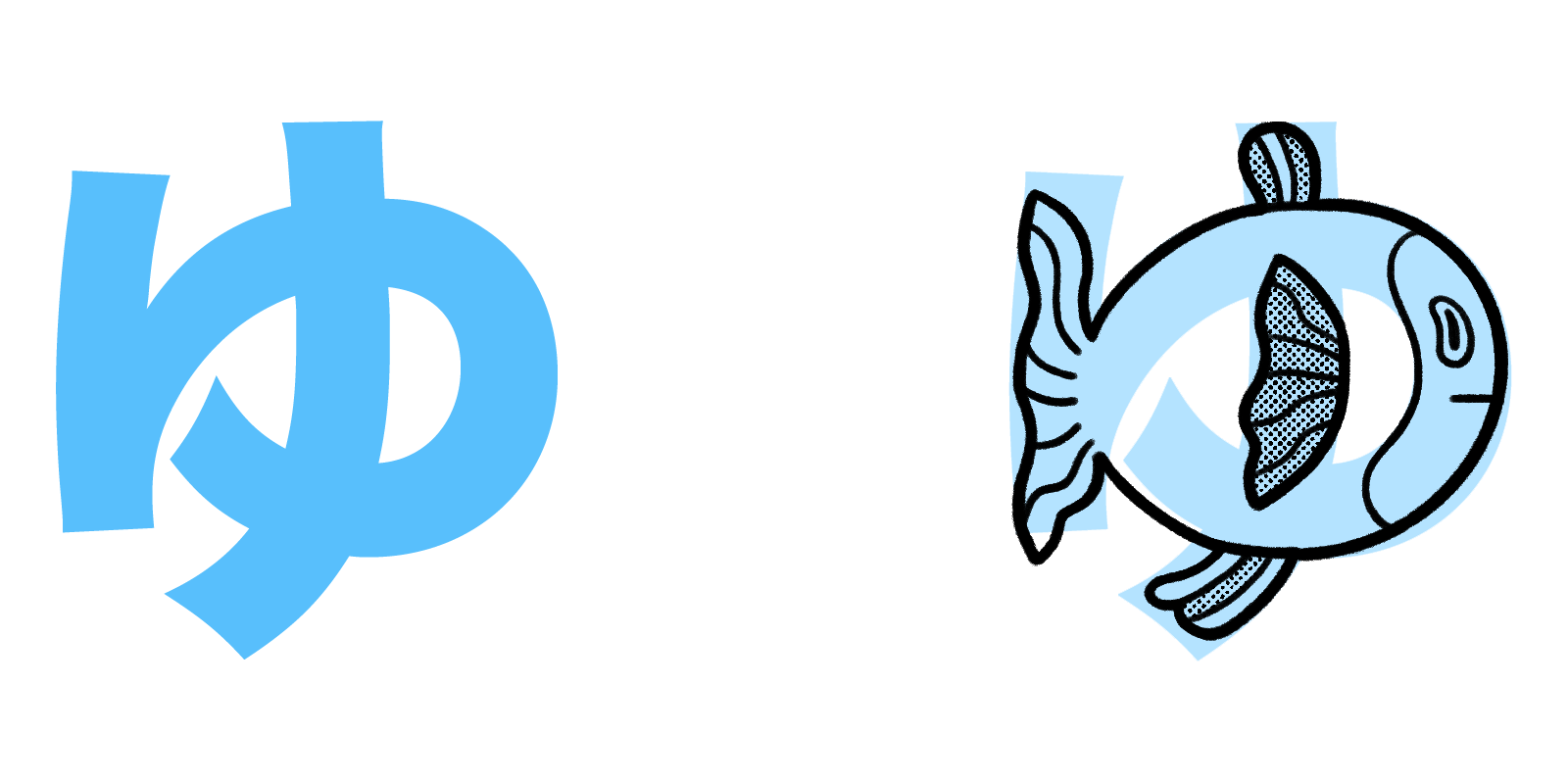
Y before う gives ゆ. Like the English word you.
Snow
Snow.
よ — yo
-
よ
yo
Yo, this kana looks like the letters Y and O. And you can play yo-yo with it — watch it slide down and back up.

Y before お gives よ. Like the “yo” in yo-yo — or yonder, in British English.
To read
To read. Which is what you have been doing for eight lessons.
The row together
Three pairs. The shortest board in the course.
Read them cold
All thirty-eight
Twice each.
Words
Every one unique. The y row opens up a lot for three characters.
Spell every word
Worth knowing
やすい and たかい — cheap and expensive. Two adjectives that between them describe most of what you will point at.
やさい is vegetables, and with さかな and にく from lesson 5 you can now read the three headings a menu is usually organised under.
The two empty slots in this row are worth a moment. The grid has ten columns and five vowels, so it promises fifty sounds — the name gojūon means exactly that, “fifty sounds”. It delivers forty-six. This row is where two of the missing four are: there is no yi and no ye in modern Japanese, so those squares stay blank rather than being filled with something that is not said.
Eight to go: ら り る れ ろ, then わ を ん.